
Our Lady of Champion Shrine
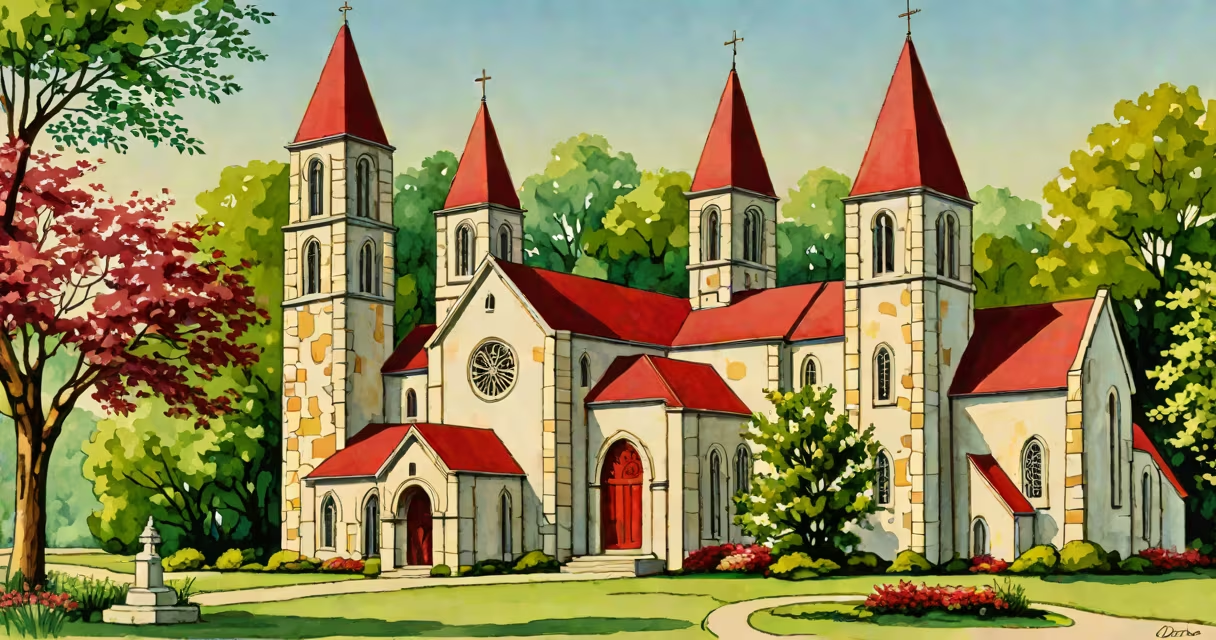
The Our Lady of Champion Shrine is a Roman Catholic place of worship in Champion, Wisconsin, built around a site where a woman named Adele Brise claimed to have seen the Virgin Mary in 1859. The apparition, later recognized by Church authorities, led to the construction of a sanctuary dedicated to Mary under the title of Our Lady of Champion.
Located in a rural area of eastern Wisconsin, the shrine sits on land originally settled by French-Canadian immigrants. The story began when Adele Brise, then 18 years old, was walking through a wooded field near her family's farm. She reported seeing a woman dressed in white with a blue mantle and a golden crown. The figure spoke to her in French, saying, "I am the Mother of God." This event marked the first authenticated Marian vision in U.S. history, confirmed by the Archdiocese of Milwaukee in 1937.
Today, the shrine draws thousands of visitors annually, especially during the annual pilgrimage held on the Sunday closest to September 8-the feast of the Nativity of Mary. Pilgrims come to pray, attend Mass, and venerate a life-sized statue of the Virgin Mary placed in the chapel's center. The site remains active, with daily Masses, confessions, and a small museum detailing the history of the apparition and the Brise family.
How the Shrine Came to Be
After Adele Brise's vision, she returned to her home and shared the message with her family and local priest. The initial reaction was skepticism. However, over time, the community began to see signs-crops improved, illnesses ceased-and people started visiting the site. By 1860, a small wooden chapel was built on the spot where the vision occurred.
In 1887, the current stone church was completed. Designed in Gothic Revival style, it features stained glass windows depicting scenes from the life of Mary and the Annunciation. The interior includes a large altar with a carved wooden statue of Our Lady of Champion, based on a painting created by a local artist in 1890. The church's foundation stones were blessed by Bishop John Henni of Milwaukee, who later became the first archbishop of the Archdiocese of Milwaukee.
Adele Brise lived to age 83 and died in 1918. She was beatified in 2018 by Pope Francis, who recognized her as a model of faith and perseverance. Her cause for canonization is ongoing, making her the first American-born woman to be beatified for a private revelation.
What the Shrine Is Made Of and How It Functions
The shrine complex consists of the main church, a small visitor center, a gift shop, and a cemetery. The church itself is constructed from locally quarried limestone and sandstone. Its walls are 3 feet thick in places, designed to withstand harsh Midwest winters. The roof is made of hand-cut cedar shingles, replaced every 30 years.
Inside, the sanctuary is lit by 12 stained glass windows. Each depicts a different aspect of Mary's life: her Immaculate Conception, her role in the Annunciation, and her presence at the Crucifixion. The central window shows the Virgin Mary standing atop a crescent moon, holding a child-symbolizing both her divine motherhood and her victory over sin.
The shrine operates on a volunteer basis. Staff and guides are drawn from nearby parishes. Daily devotions include Morning Prayer at 7:00 a.m., Mass at 9:00 a.m., and evening prayer at 6:00 p.m. During high season (June through August), a live choir performs at 10:30 a.m. Mass on Sundays.
Types of Devotion and Common Misconceptions
Visitors engage in several forms of devotion at the shrine. The most common is the rosary walk-a path lined with Stations of the Cross leading from the parking lot to the church door. Pilgrims often stop at each station to pray aloud. Another practice is the candle offering: visitors light a votive candle and place it in a designated holder, symbolizing their prayers being sent to heaven.
Some assume the shrine is a national pilgrimage destination like Lourdes or Fatima. It is not. It is a regional site with deep roots in the Catholic communities of Wisconsin and Michigan. Unlike those international shrines, it lacks a formal healing program or medical documentation of miracles. However, the Church has validated the authenticity of the 1859 apparition through a process called *confirmatio*-a formal review of the testimony and historical evidence.
A common misunderstanding is that the vision occurred in a church building. It did not. The apparition happened outdoors, in a forest clearing. The original wooden chapel stood on the same ground until it burned down in 1910. The current structure was built on the same foundation, preserving the original footprint.
Why the Shrine Matters and What It's Often Confused With
The shrine holds unique significance because it is the only Marian apparition in the United States officially recognized by the Church. While other visions-like those at Medjugorje or Garabandal-are still under investigation, Our Lady of Champion received formal approval from the Archdiocese of Milwaukee in 1937. This validation allows Catholics to venerate the image and visit the site with ecclesiastical sanction.
It is frequently mistaken for the Basilica of Our Lady of Guadalupe in Mexico City. The two share a name but differ in origin, location, and theological context. The Mexican shrine is rooted in a 1531 vision of Juan Diego and is a major global pilgrimage site. The American shrine, while smaller, reflects the growth of Catholicism in rural North America during the 19th century.
Another confusion arises from the term "Champion." The town was named after a local Native American chief, not the Virgin Mary. The name was chosen in 1857 by settlers who admired his courage. The connection to Mary came later, through the vision.
| Feature | Our Lady of Champion Shrine | Basilica of Our Lady of Guadalupe |
|---|---|---|
| Location | Champion, Wisconsin, USA | Tepeyac Hill, Mexico City, Mexico |
| Apparition Date | 1859 | 1531 |
| Recognition Status | Officially approved by Church (1937) | Recognized by Church since 1531 |
| Annual Visitors | ~15,000 | ~5 million |
| Primary Language of Services | English, Polish, Spanish | Spanish, English |
I visited the shrine in October 2022 during a cold autumn morning. The air was crisp, and the leaves crunched underfoot as I walked the path to the church. Inside, the scent of beeswax candles filled the space. A group of elderly women knelt at the altar, whispering prayers in Polish. I joined them briefly. The silence felt sacred-not empty, but full of presence.
One non-obvious fact often overlooked: the original vision site lies within a protected conservation area. The land was donated by the Brise family in 1860 and remains under the stewardship of the Diocese of Green Bay. No commercial development is permitted. This preservation ensures the site remains unchanged from the time of the vision.
For those seeking spiritual renewal or a deeper connection to Catholic tradition, the Our Lady of Champion Shrine offers a rare opportunity to stand on ground where a vision was witnessed and verified. It is not a grand cathedral, nor a tourist attraction. It is a quiet place of memory, faith, and continuity. The shrine exists not to impress, but to invite reflection.