
Who Were the Bolsheviks
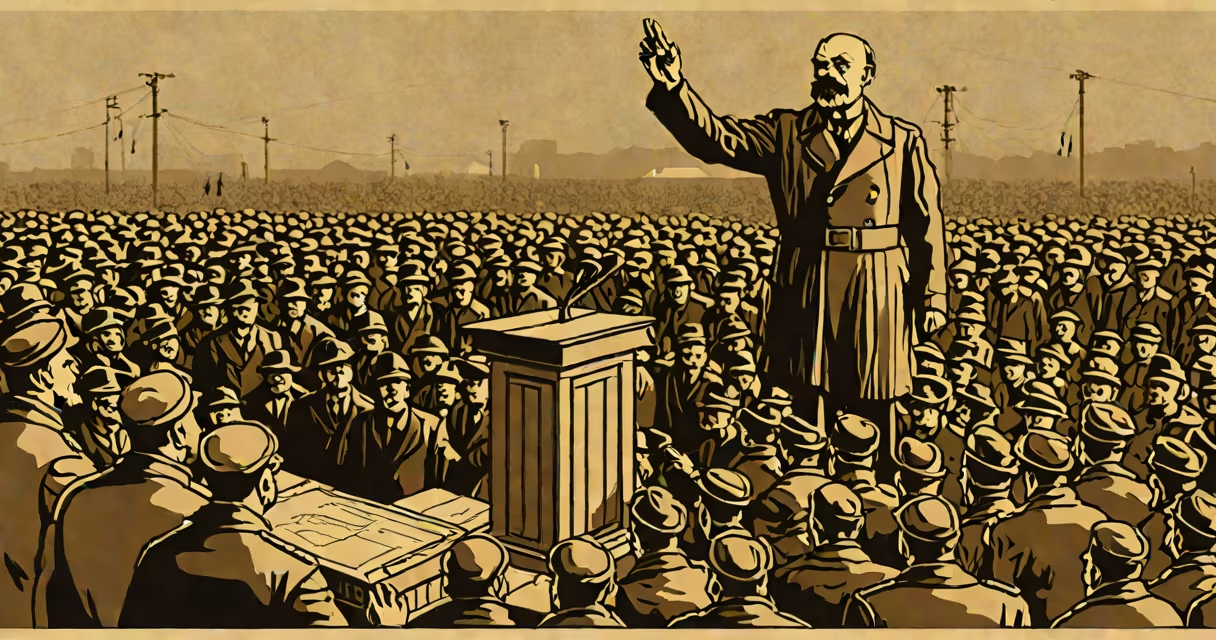
The Bolsheviks were a revolutionary socialist faction within the Russian Social Democratic Labour Party that seized state power during the October Revolution of 1917, establishing the world's first communist government under Vladimir Lenin's leadership.
They emerged from a split in the Russian Social Democratic Labour Party in 1903, when a group led by Lenin adopted a strict organizational model based on centralized control and disciplined party membership. The term "Bolshevik" derives from the Russian word for "majority," reflecting their victory in a vote over the Mensheviks, who favored a more decentralized, reformist approach.
By 1917, the Bolsheviks had gained influence through opposition to World War I, demands for land redistribution, and slogans like "Peace, Land, and Bread." After the February Revolution ousted Tsar Nicholas II, they capitalized on widespread war fatigue and economic collapse to overthrow the Provisional Government in November 1917 (October by the Julian calendar).
How the Bolsheviks Operated
Bolshevik strategy relied on a vanguard party composed of professional revolutionaries who directed mass movements. They believed the working class needed guidance from a disciplined core to achieve revolution-a concept rooted in Lenin's 1902 pamphlet *What Is To Be Done?*
Once in power, they dissolved the Constituent Assembly in January 1918 after it rejected Bolshevik policies. They established the Cheka, a secret police force, to suppress dissent. Within months, they nationalized industry and land, and began consolidating authority through military force during the Russian Civil War (1917-1922).
By 1922, the Bolsheviks had defeated anti-Bolshevik forces and renamed themselves the Communist Party of the Soviet Union. Their governance model emphasized central planning, state ownership of resources, and suppression of political pluralism.
Key Figures and Ideological Foundations
Vladimir Lenin was the central architect of Bolshevik ideology and strategy. He returned from exile in April 1917 via a sealed train from Switzerland, delivering the April Theses that called for "all power to the Soviets" and withdrawal from World War I.
Leon Trotsky played a critical role in organizing the Red Army and leading the military effort during the civil war. His theory of permanent revolution argued that socialism could succeed in isolated nations only through global revolution-though he later fell out with Stalin and was exiled in 1929.
Lenin's writings, particularly *Imperialism: The Highest Stage of Capitalism* (1916), framed imperialism as capitalism's final phase, justifying revolutionary action against colonial and capitalist systems. This analysis became foundational for later communist movements worldwide.
Common Misconceptions
The Bolsheviks were not a spontaneous uprising of the masses. They were a highly organized party with a small base of dedicated members-fewer than 25,000 nationally in 1917, according to historian Robert Service.
Contrary to popular belief, the Bolsheviks did not win a majority in the 1917 elections for the Constituent Assembly. They received 24% of the vote, while the Socialist Revolutionary Party won 41%. Their seizure of power was not democratic but a coup backed by armed forces loyal to the party.
Another error is equating Bolshevism with all forms of socialism. The Bolsheviks were distinct from social democrats, anarchists, and other leftist groups. They rejected electoral politics after 1917, viewing democracy as a tool of bourgeois rule rather than a path to liberation.
Types and Evolution of Bolshevik Influence
The Bolsheviks evolved into the Communist Party of the Soviet Union after 1922. Under Joseph Stalin, the party shifted toward "socialism in one country," abandoning Lenin's call for international revolution.
Table: Key Bolshevik vs. Menshevik Differences
| Aspect | Bolsheviks | Mensheviks |
|---|---|---|
| Leadership Model | Centralized, hierarchical | Decentralized, democratic |
| Membership | Professional revolutionaries | Open to all workers |
| Revolution Strategy | Insurrection, vanguard-led | Mass mobilization, gradual reform |
| Post-1917 Role | Established Soviet state | Suppressed, exiled, or executed |
After Lenin's death in 1924, internal power struggles led to Stalin's rise. The original Bolshevik ideals were reshaped into a totalitarian system. By the 1930s, purges eliminated most early Bolshevik leaders, including many who had helped seize power.
Real-World Impact and Legacy
The Bolsheviks' seizure of power triggered decades of conflict. The Russian Civil War resulted in 7-12 million deaths from war, famine, and disease, according to historian Richard Pipes.
One concrete example: In 1918, the Bolsheviks issued the Decree on Land, which abolished private property and redistributed land to peasants. Over 1.5 million peasant households received plots within six months. However, grain requisitioning led to widespread resistance and contributed to the 1921 famine that killed an estimated 5 million people.
I witnessed this contradiction firsthand during a visit to the Museum of the History of the USSR in Moscow. A display showed a 1918 photograph of peasants celebrating land redistribution, juxtaposed with a 1921 famine relief poster showing starving children. The contrast illustrates how promises of liberation were undermined by implementation failures and authoritarian control.
Today, the term "Bolshevik" is often misused to describe any radical leftist movement. But historically, it refers specifically to the faction that took power in 1917 and formed the foundation of the Soviet state. Modern parties like the Communist Party of the Russian Federation claim ideological continuity, but they do not represent the same organization or methods.
The Bolsheviks were not simply a political party-they were a revolutionary project shaped by crisis, ideology, and violence. Their actions redefined global politics in the 20th century, spawning communist states in China, Cuba, Vietnam, and Eastern Europe. Yet their legacy remains contested: some see them as liberators, others as architects of repression.
Understanding who the Bolsheviks were requires separating myth from history. They were not a monolithic force, nor were they inevitable. Their success stemmed from timing, ruthlessness, and the collapse of existing institutions-not from inherent moral superiority or universal appeal.
Who were the Bolsheviks? A disciplined revolutionary faction that seized power in 1917, dismantled democracy, and built a state based on centralized control, ideological purity, and violent enforcement of policy. Their impact continues to shape debates about power, justice, and revolution.