
What Do Pipeline Welders Do
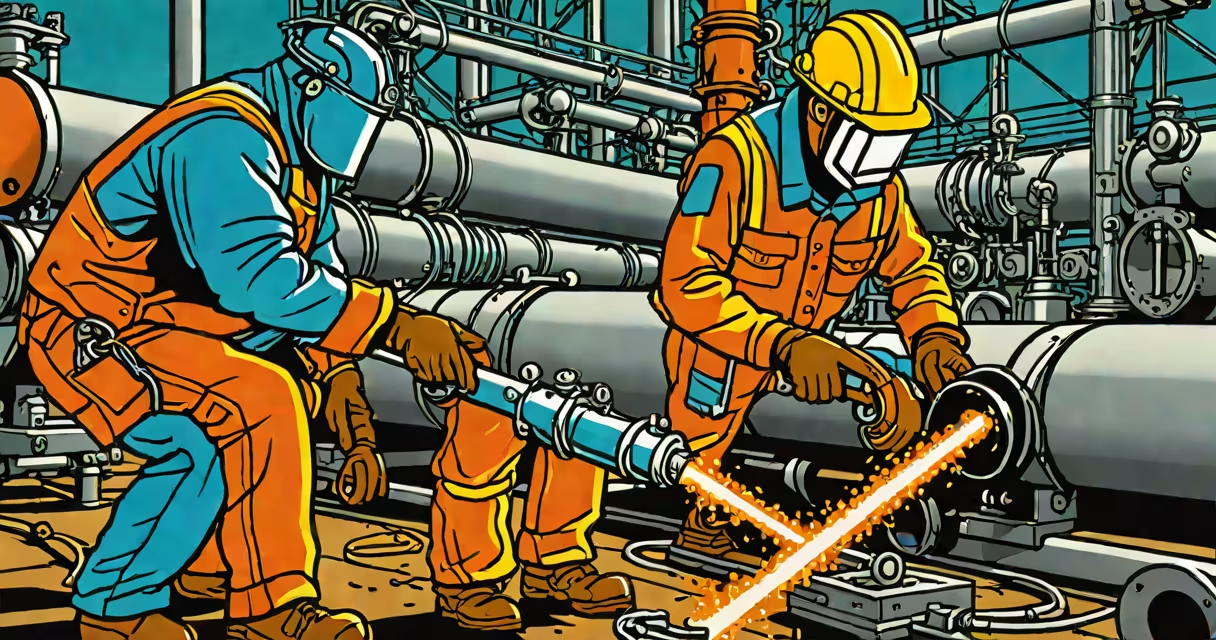
Pipeline welders assemble, inspect, and repair high-stress metal pipelines used in oil, gas, and chemical transport. They apply precise heat and fusion techniques to join pipe sections under strict quality standards, ensuring long-term integrity in high-pressure environments.
These professionals operate in remote locations-deserts, tundra, offshore platforms-where pipelines carry energy resources across continents. Their work prevents leaks, explosions, and environmental damage. A single failed weld can cost millions in repairs and downtime.
Welders follow codes set by the American Society of Mechanical Engineers (ASME) and the American Petroleum Institute (API). These standards mandate specific procedures, materials, and inspection methods. Failure to comply voids certifications and exposes companies to legal liability.
How Pipeline Welding Works
Welding begins with joint preparation. Pipe ends are machined to precise angles and cleaned of contaminants. Misalignment greater than 1/16 inch (1.6 mm) can cause stress fractures under pressure. The welder then applies heat using shielded metal arc welding (SMAW), gas tungsten arc welding (GTAW), or flux-cored arc welding (FCAW).
Each method suits different conditions. SMAW uses coated electrodes and works well in wind or rain. GTAW delivers high accuracy for thin-wall pipes. FCAW allows faster deposition in thick-section joints. The choice depends on material grade, thickness, and environment.
After welding, the joint undergoes non-destructive testing (NDT). Techniques include radiographic testing (X-ray), ultrasonic testing (UT), and dye penetrant inspection. A weld must pass all tests before being approved for service. For example, API 1104 requires 100% radiographic inspection for pipelines carrying flammable fluids.
Types of Pipeline Welds and Their Uses
Welders perform several joint configurations based on pipe orientation and load requirements:
| Type | Use Case | Common Material | Standard |
|---|---|---|---|
| Butt Joint | Long straight runs; high-pressure lines | Carbon steel, X52, X65 | ASME B31.4, API 1104 |
| Socket Weld | Small-diameter piping; tight spaces | Stainless steel, alloy 825 | ASME B16.11 |
| End Cap Weld | Sealing pipe ends; pressure vessels | Alloy 625, 316L stainless | ASME BPVC Section VIII |
Butt joints are most common in major pipeline projects. They require full-penetration welds with backing rings or root passes. Socket welds are used in process piping where space is limited. End cap welds seal closed ends under internal pressure.
A key distinction: pipe diameter affects weld complexity. A 2-inch pipe may take 30 minutes to weld. A 48-inch pipeline segment can take 8 hours per joint due to multiple passes and cooling time between layers.
Where and Why Pipeline Welders Are Needed
Oil and gas pipelines span over 2 million miles globally. In North America alone, over 200,000 miles of transmission lines move crude oil and natural gas. Each mile contains hundreds of welded joints. Maintenance and expansion demand continuous welding operations.
Major projects like the Keystone XL and Trans Mountain Expansion required tens of thousands of qualified welders. Contractors hire certified welders through union halls or private training programs. Certification is not automatic-it requires passing written exams and practical weld tests under supervision.
Welders often work in teams of three: the welder, the inspector, and the assistant. The welder performs the joint. The inspector checks alignment and surface defects before welding. The assistant handles material handling and equipment setup. This division reduces error rates and improves workflow efficiency.
Common Misconceptions and Corrections
Many assume pipeline welding is purely physical labor. In reality, it's highly technical. A welder must read blueprints, interpret weld symbols, and calculate joint tolerances. For example, a 1/8-inch misalignment in a 12-inch pipe can reduce fatigue life by 40% according to ASME B31.8 guidelines.
Another myth: all welders use the same technique. That's false. Field conditions dictate method selection. In Arctic regions, welders use preheat and post-heat cycles to prevent hydrogen cracking. In tropical zones, they adjust shielding gas flow to avoid porosity from moisture.
One non-obvious fact: welders don't always see their work. After a joint is welded, it's often buried underground or covered in insulation. The final inspection happens via X-ray or ultrasound. A welder may never see the completed pipeline-only the test results.
Real-World Example: Alaska Pipeline Repair
In 2017, a leak was detected in the Trans-Alaska Pipeline near Prudhoe Bay. Engineers traced it to a girth weld that failed after 30 years of service. A team of 12 welders was deployed to replace the section.
The site was at -40°F (-40°C). Welders used low-hydrogen electrodes and applied preheat of 250°F (121°C) to prevent cracking. Each joint took 14 hours to complete: 4 hours for prep, 6 hours for welding, and 4 hours for cooling and inspection.
After completion, radiographic testing revealed no flaws. The pipeline resumed operation within 72 hours. The project cost $1.2 million but prevented a potential spill of 10,000 barrels of crude oil.
Personal Experience: A Day in the Field
I once observed a crew repairing a pipeline in western Texas. The welder had to complete a root pass on a 36-inch pipe at 30 feet above ground. Wind gusts reached 35 mph. He adjusted his shielding gas flow rate every 90 seconds to compensate for drift.
He paused midway to check the amperage with a handheld meter. A deviation of 5 amps could have caused burn-through. After finishing, he documented the weld parameters in a digital log. The data was uploaded to a central system for audit purposes.
That night, the team reviewed the welds using a portable X-ray device. One joint showed a small lack of fusion. The welder returned the next morning to rework it. Compliance wasn't optional-it was mandatory.
Final Thoughts
Pipeline welders are essential to global energy infrastructure. Their work ensures safe, uninterrupted flow of fuel and chemicals across vast distances. Each weld is a calculated act of engineering precision under pressure-both literal and operational.
Understanding what pipeline welders do reveals a profession rooted in skill, discipline, and responsibility. Mistakes aren't just costly-they're dangerous. The next time you turn on a heater or fill your car, remember the unseen welds holding the system together.