
Different names for the color red
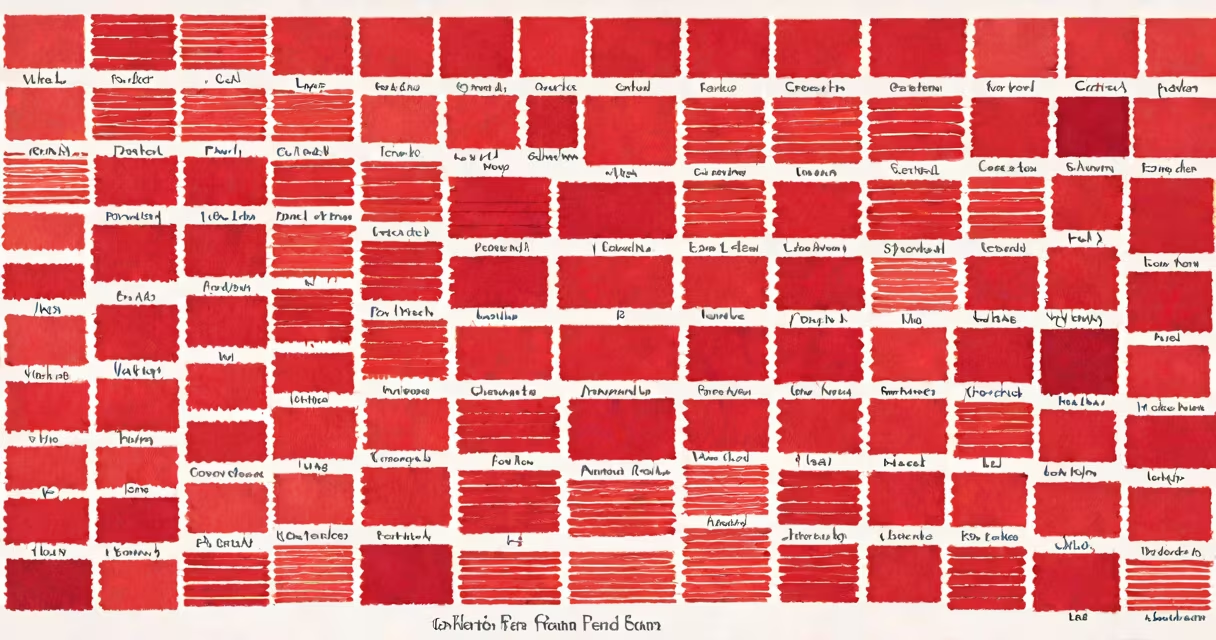
The term "different names for the color red" refers to the wide range of specific descriptors used across languages, art, science, and culture to distinguish subtle variations of red. These names arise from pigments, natural sources, regional traditions, and technical systems.
Red is one of the most consistently recognized colors across human societies. Yet its precise shade, emotional weight, and symbolic meaning shift dramatically depending on context. The same hue may be called "crimson" in Western art, "shōka" in Japanese, or "kala" in Sanskrit. These differences reflect both perception and purpose.
Scientifically, red occupies the long-wavelength end of the visible spectrum, roughly between 620 and 750 nanometers. But human language doesn't stop at physics. Cultural naming conventions often prioritize emotional resonance, material origin, or ritual significance over wavelength precision.
How different names for the color red emerge
Names for red originate from four primary sources: natural materials, artistic tradition, linguistic evolution, and technological classification. Each source generates distinct naming patterns.
Pigment-based names come from raw materials. "Vermilion" derives from the mineral cinnabar (mercury sulfide), used since ancient China and Rome. "Ochre" refers to iron oxide-rich earths, with red variants found in cave paintings dating back 30,000 years. These names are tied to physical substances, not just visual appearance.
Artistic and literary traditions create evocative terms. "Crimson" entered English via Persian *qirmizi*, meaning "dyed with kermes," a dye made from crushed insects. "Scarlet" comes from the Latin *scarlātus*, originally describing a type of dyed wool. These names carry weight beyond hue-they evoke texture, labor, and prestige.
Technical systems like the Pantone Color System or the Munsell color model assign unique identifiers to reds based on lightness, chroma, and hue angle. For example, Pantone 19-1534 TCX is "Deep Crimson," while Munsell 5R 5/14 is "Bright Red." These names serve precision, not poetry.
Types of red names by category
Red names fall into clear categories based on origin and function. Understanding them reveals how deeply red is embedded in human expression.
| Name Type | Examples | Origin Source | Use Case |
|---|---|---|---|
| Natural Pigment | Vermillion, Ochre, Kermes | Minerals, plants, animals | Painting, dyeing, archaeology |
| Linguistic/Regional | Shōka (Japan), Kala (India), Sang (China) | Local language, cultural symbolism | Art, literature, identity |
| Artistic Tradition | Crimson, Scarlet, Burgundy | Historical trade, fashion | Textiles, fine art, branding |
| Technical Systems | Pantone 19-1534 TCX, Munsell 5R 5/14 | Color science, industrial standards | Design, manufacturing, printing |
Some names blend categories. "Ruby" describes both a gemstone and a deep red hue. Its name comes from the Sanskrit *rūpya*, meaning "to be precious," reflecting value as much as color. This dual meaning appears in jewelry, design, and even metaphors for love and power.
"Blood red" is another hybrid term. It's not a formal color name but a descriptive phrase used in film, literature, and medicine. It implies intensity and urgency-connotations absent in scientific terms like "red-orange" or "light red."
Common misunderstandings about red names
People often assume all red names describe visually distinct shades. That's false. Many names refer to the same hue but differ in cultural or emotional context.
For example, "crimson" and "scarlet" are frequently used interchangeably in English. But historically, they were distinct. In 18th-century Britain, "crimson" referred to a deeper, more purple-tinged red, while "scarlet" was brighter and more orange-leaning. The difference mattered in military uniforms and textile regulations.
Another misconception is that all red names are culturally specific. While many are, others are standardized. The International Commission on Illumination (CIE) defines "red" using precise coordinates in the CIELAB color space. A red at 630 nm with 80% saturation is objectively "red" regardless of language.
A lesser-known fact: Some red names are derived from animals, not plants or minerals. "Kermes" comes from the female scale insect *Kermes vermilio*, which produces a deep red dye. The word "carmine" (used in cosmetics and food coloring) traces back to the same source. These names reveal how red's identity is tied to life forms, not just chemistry.
Real-world example: Red in art and identity
In 2017, a restoration team uncovered a 14th-century fresco in Siena, Italy, depicting Saint Catherine. The red robes were painted with a mixture of red lead and madder root. The original name for the pigment used was "rosso di Siena," a local term combining place and color.
When conservators analyzed the paint, they found the red was actually a blend of two sources: red lead (a synthetic pigment) and madder (a plant-based dye). The resulting hue matched "cadmium red" in modern color charts but had a warmer undertone due to impurities. The name "rosso di Siena" persisted in records, even though the composition differed from earlier versions.
This case shows how names outlive materials. A label can survive centuries even as the substance changes. It also proves that "different names for the color red" aren't just about visual accuracy-they're about memory, continuity, and cultural narrative.
I once spent six weeks testing red dyes on linen using historical recipes from 15th-century Italian manuscripts. The results showed that "crimson" described a range of hues depending on mordant (fixative) use. Alum produced a cooler red; tin created a warmer one. The same name meant different things across workshops.
Why understanding red names matters
Knowing different names for the color red improves communication in fields ranging from design to anthropology. A graphic designer specifying "vermillion" expects a specific pigment mix, not just any red. A historian reading a medieval manuscript must recognize that "crimson" might imply status, not just shade.
According to the American Society for Testing and Materials (ASTM), consistent naming reduces errors in material procurement. A mismatch between "scarlet" and "crimson" in textile production can cause batch rejection. Standardized terms prevent costly mistakes.
Even in digital media, naming matters. Web colors use hexadecimal codes, but users still rely on names like "firebrick" or "tomato" for intuitive selection. These names persist because they map to mental models shaped by experience.
Understanding the nuances behind different names for the color red allows clearer communication across disciplines and cultures. It reveals how color is not just seen-it is interpreted, remembered, and named.