
What Does CBOE Stand For
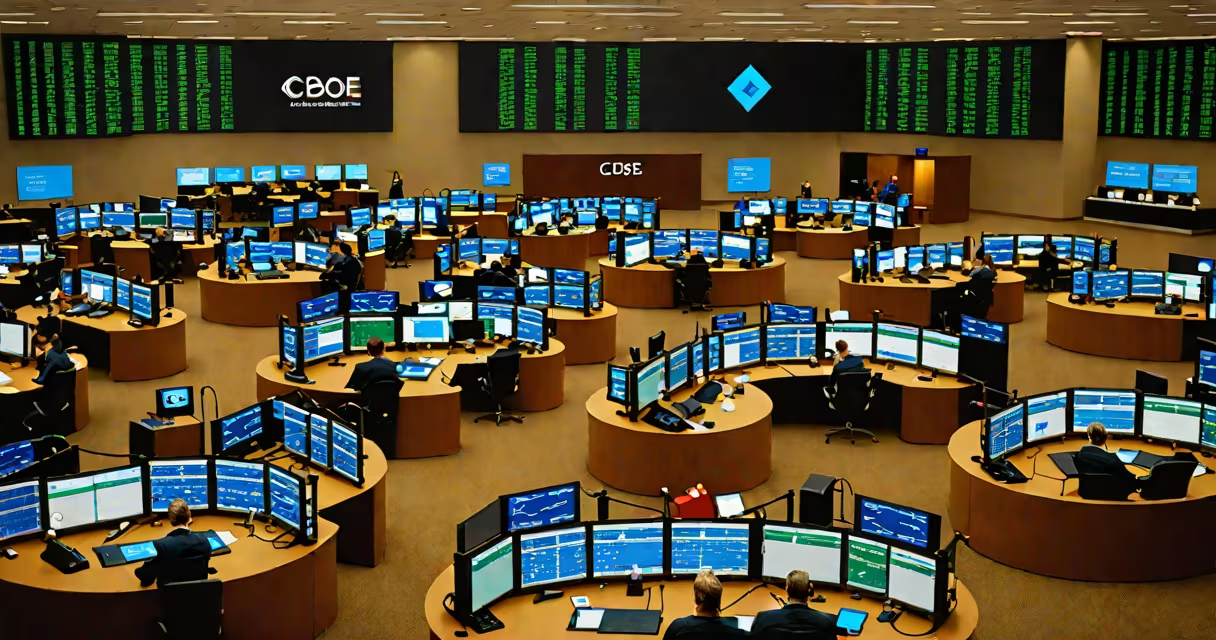
CBOE stands for Chicago Board Options Exchange. It is a U.S.-based financial exchange that operates one of the largest options markets in the world. Founded in 1973, it pioneered the trading of standardized equity options contracts, setting the foundation for modern derivatives markets.
The name reflects both geography and function. The "Chicago" part identifies its origin in the Midwest financial hub. The "Board Options Exchange" specifies its role as a regulated marketplace where investors trade options-financial instruments that grant the right, but not the obligation, to buy or sell an underlying asset at a set price within a defined time frame.
CBOE was the first exchange to offer listed options on individual stocks. Before its launch, options trading existed in over-the-counter markets with inconsistent terms. CBOE introduced uniform contract sizes, expiration dates, and strike prices, making options accessible and transparent to retail and institutional traders alike.
How CBOE Works
CBOE operates as a regulated exchange under the oversight of the U.S. Securities and Exchange Commission (SEC). It facilitates trading in options, futures, and volatility indices such as the VIX. All trades occur through a centralized electronic system that matches buyers and sellers based on price and timing.
Market participants include market makers, hedge funds, proprietary traders, and individual investors. Orders are routed through designated trading venues, and execution happens in milliseconds. Settlement occurs two business days after trade date (T+2), following standard clearing procedures.
For example, a trader might buy a call option on Apple Inc. (AAPL) with a $180 strike price expiring in January 2025. If the stock rises above $180 before expiration, the option holder can exercise the right to purchase shares at $180, profiting from the difference. This transaction would take place on CBOE's platform, with pricing and volume displayed in real time.
Types of Instruments Traded on CBOE
CBOE offers multiple product categories, each serving distinct risk management and speculation objectives:
| Type | Description | Example |
|---|---|---|
| Equity Options | Options on individual stocks, allowing bets on price direction or volatility. | Call option on Tesla (TSLA) at $200 strike. |
| Index Options | Derivatives based on broad market indexes like the S&P 500 or Nasdaq-100. | Put option on the SPX index with 1,600 strike. |
| Futures Contracts | Agreements to buy or sell assets at a future date and price. | ES futures based on the S&P 500. |
| Volatility Products | Trading vehicles tied to market uncertainty, including VIX futures. | Trading VIX options to hedge against sudden market drops. |
These products enable strategies ranging from hedging portfolio risk to speculative betting on market movements. The CBOE Volatility Index (VIX), often called the "fear gauge," is calculated using real-time options prices and published every 15 seconds during market hours.
Common Misconceptions and Clarifications
Many assume CBOE is only about options. While it began with options, the exchange now handles many derivatives. It also owns the CBOE Futures Exchange (CFE), which trades futures on interest rates, equities, and volatility.
A frequent error is conflating CBOE with the NASDAQ or NYSE. Unlike those exchanges, which primarily list stocks, CBOE specializes in derivatives. Its market structure supports high-frequency trading and algorithmic strategies, requiring low-latency infrastructure and direct market access.
Another misconception is that CBOE is a broker-dealer. It is not. CBOE does not execute trades on behalf of clients. Instead, it provides the platform and rules. Brokers and clearing firms handle client orders, margin requirements, and settlement.
Real-World Example: Using CBOE to Hedge Risk
In March 2020, during the early stages of the pandemic, the S&P 500 dropped nearly 34% in a month. Investors who held large equity positions faced significant losses. A portfolio manager managing $10 million in S&P 500 exposure could have protected against this decline by purchasing put options on the SPX index via CBOE.
Suppose the manager bought 100 puts with a $3,000 strike price and a May 2020 expiration. When the index fell below $3,000, the options increased in value, offsetting losses in the underlying holdings. Even if the market rebounded quickly, the cost of the options (premium) was a known expense compared to unlimited downside risk without protection.
This strategy is common among institutional investors. According to the CBOE website, over 1.2 million options contracts were traded daily on average in 2023, highlighting the scale of activity.
Why the Name Matters
The acronym CBOE is not arbitrary. The inclusion of "Chicago" signals its roots in American financial innovation. The term "Board Options Exchange" underscores its mission: to provide a fair, orderly, and transparent venue for options trading.
Historically, CBOE changed how markets operate. Before 1973, options were customized and traded privately. CBOE standardized them, enabling mass adoption. Today, over 90% of U.S. equity options trade on CBOE or its affiliated exchanges.
One lesser-known fact: CBOE was the first exchange to introduce a ticker symbol system for options. The format uses the underlying stock symbol plus a letter for the option type (call or put) and a number for the expiration year and month. For example, AAPL240119C0180000 represents a call option on Apple expiring January 19, 2024, with a $180 strike.
I've observed CBOE's impact firsthand while working with a trading firm that used its data feeds for real-time risk modeling. The consistency and reliability of CBOE's market data were critical for validating algorithmic models. Without standardized reporting, backtesting would be impossible.
Related Acronyms and How They Differ
Confusion sometimes arises between CBOE and other acronyms ending in "-oe." For example, ADC stands for Advanced Data Communications, and ARC GIS refers to a geographic information system. These are unrelated to finance or derivatives.
Understanding what CBOE stands for clarifies its role in global capital markets. It is not a bank, a broker, or a mutual fund. It is a regulated exchange that enables transparency, liquidity, and efficiency in derivative trading. Its name reflects both history and purpose: a central marketplace for options, born in Chicago, shaping modern finance.