
Types of Ecological Pyramids
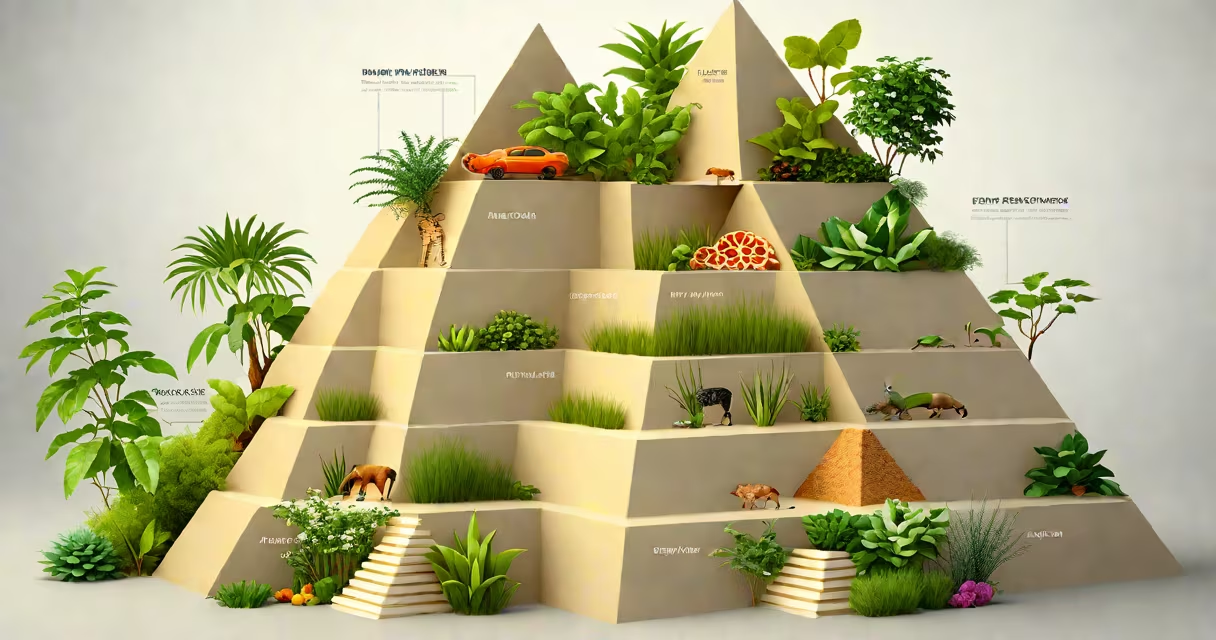
Ecological pyramids are graphical representations that illustrate the flow of energy, biomass, or numbers of organisms through trophic levels in an system. They show how energy decreases from producers to top consumers, with each level supporting fewer individuals or less mass.
These models are based on quantitative data collected from field studies. The three standard types-pyramid of energy, pyramid of biomass, and pyramid of numbers-each reveal different aspects of system structure. Energy pyramids always appear upright because energy diminishes at each transfer due to metabolic loss. Biomass and numbers pyramids can invert under certain conditions, such as in aquatic systems where small producers support large consumer populations.
Ecologists use these pyramids to assess system stability, productivity, and resilience. For example, a collapsing fish population in a lake may first show reduced biomass in secondary consumers, visible in a flattened biomass pyramid. Data from long-term monitoring programs like the Long-Term Ecological Research Network confirm that energy pyramids remain consistent across diverse biomes.
How Ecological Pyramids Work
Each level in a pyramid represents a trophic level: producers (plants, algae), primary consumers (herbivores), secondary consumers (carnivores), and tertiary consumers (top predators). Energy enters the system via photosynthesis and moves upward through feeding relationships.
At each transfer, approximately 90% of energy is lost as heat through respiration, excretion, and movement. This 10% rule means only about 10% of energy from one level is converted into biomass at the next. A single kilogram of grass supports roughly 100 grams of grasshopper biomass, which in turn supports about 10 grams of frog biomass.
This progressive reduction creates a pyramid shape. Without this energy loss, ecosystems could sustain far more top predators than they do. In a forest, a single deer may consume 50 kilograms of vegetation annually, but the predator that eats it-say, a wolf-must hunt multiple deer to meet its caloric needs.
Three Main Types of Ecological Pyramids
The three types differ in what they measure and how they represent data. They are not interchangeable; each reveals unique patterns in system dynamics.
| Type | Measures | Shape | Common Example |
|---|---|---|---|
| Pyramid of Energy | Energy flow per unit area per unit time (kcal/m²/year) | Always upright | Temperate forest: 10,000 kcal/m²/yr in plants → 1,000 in herbivores → 100 in carnivores |
| Pyramid of Biomass | Total dry weight of living material at each level (g/m²) | Usually upright, sometimes inverted | Marine system: phytoplankton biomass lower than zooplankton due to rapid turnover |
| Pyramid of Numbers | Number of individual organisms per unit area | Often upright, frequently inverted | Tree in a forest: one oak tree supports hundreds of insects and thousands of birds |
Energy pyramids are universally upright because energy cannot be created or recycled. According to the laws of thermodynamics, energy conversion between trophic levels is inefficient. The U.S. Environmental Protection Agency notes that no system sustains more than four trophic levels due to energy constraints.
Biomass pyramids can invert in aquatic environments. In lakes, phytoplankton reproduce rapidly and have short lifespans. Their standing biomass may be low compared to zooplankton, which live longer and accumulate more mass. This inversion reflects turnover rates, not total production.
Numbers pyramids often invert in forests. One large tree supports many insects, which in turn feed dozens of birds. A single oak can host over 300 species of insects, and each insect may be eaten by multiple bird species. This results in more individuals at higher trophic levels than at the base.
Common Misconceptions and Key Distinctions
Many assume that all ecological pyramids must be upright. This is false. Only energy pyramids are consistently upright. Biomass and numbers pyramids can invert, especially in marine and forest ecosystems.
A common error is equating pyramid shape with system health. An inverted biomass pyramid in a coral reef does not indicate collapse-it reflects high productivity and rapid consumption. Coral reefs produce more biomass per day than most terrestrial systems, yet their standing biomass remains low due to constant grazing.
Another confusion arises between biomass and production. Standing biomass measures current mass; productivity measures energy input over time. A desert cactus may have high biomass but low annual production. Its energy pyramid still shows decreasing values upward, even if the base appears massive.
I once observed a classroom experiment using a simulated pond system. Students counted organisms and estimated biomass. They expected a standard pyramid, but the numbers pyramid inverted: 100 tadpoles fed on 10 dragonfly larvae, which consumed 1000 mosquito larvae. The inversion surprised them until we discussed turnover rates and life cycles.
Why These Differences Matter in Real Ecosystems
Understanding the differences between pyramid types prevents misinterpretation of ecological data. For example, a declining fish population in a river might show a shrinking biomass pyramid, but if the numbers pyramid remains stable, it suggests recruitment failure rather than overfishing.
Conservation planning relies on accurate pyramid analysis. In the Amazon rainforest, deforestation reduces producer biomass, causing cascading effects visible in downward shifts in all three pyramid types. The World Wildlife Fund reports that 17% of the Amazon's forest cover has been lost since 1970, directly impacting energy flow and species abundance.
Climate change alters pyramid structures. Warmer oceans reduce phytoplankton growth, leading to smaller energy pyramids in marine food webs. Satellite data from NASA's Ocean Biology Processing Group confirms a 10% decline in global phytoplankton biomass since 1980, affecting entire marine ecosystems.
When assessing system function, researchers prioritize energy pyramids for accuracy. As stated in Ecology: Concepts and Applications by Manuel C. Molles Jr., "The pyramid of energy is the only one that accurately reflects the flow of energy through a system." Biomass and numbers pyramids offer useful snapshots but require context to interpret correctly.