
Bhagwan Shree Rajneesh
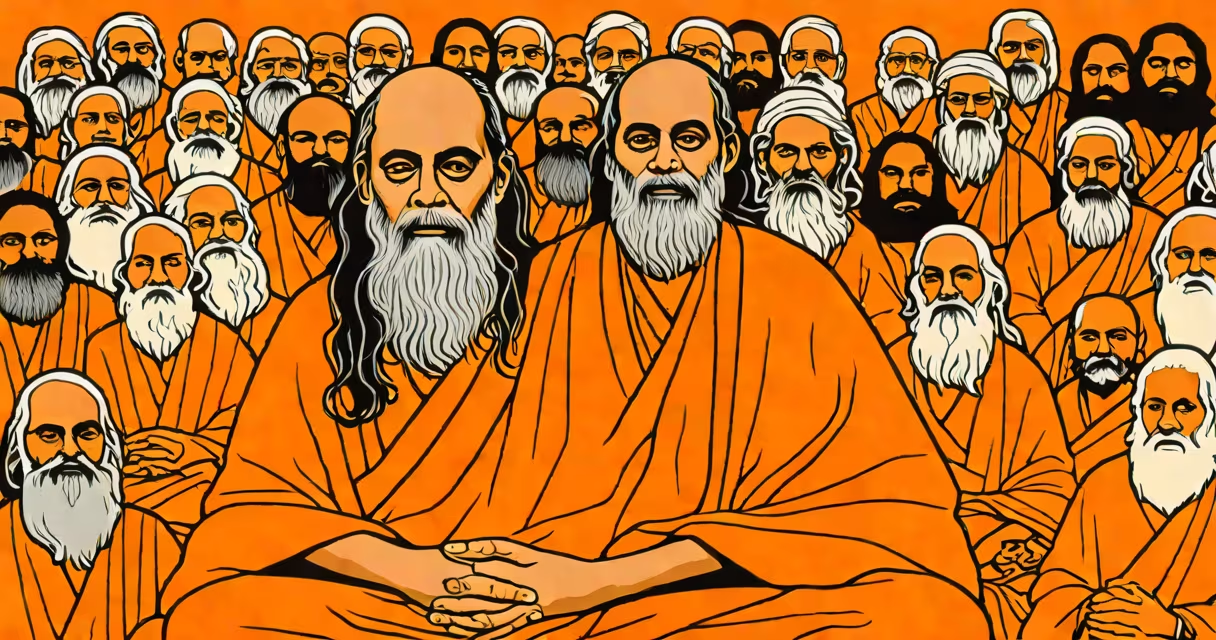
Bhagwan Shree Rajneesh was an Indian-born spiritual teacher who gained international attention in the 1970s through a unique blend of meditation, existential philosophy, and countercultural practices. He later changed his name to Osho and became the leader of a global movement centered on personal transformation, mindfulness, and radical self-expression.
He was born Chandra Mohan Jain in 1931 in Jabalpur, India. After studying philosophy at the University of Jabalpur, he began teaching in the late 1950s under the name Rajneesh. His early lectures attracted large audiences across India, drawing on Hindu, Buddhist, and Sufi traditions while challenging orthodox religious structures. By the mid-1970s, he had relocated to the United States, establishing a commune in Antelope, Oregon, which eventually grew into a 60,000-acre complex known as Rajneeshpuram.
The movement's core practice was changing meditation-a 1-hour session involving rapid breathing, loud chanting, and sudden stillness. Followers reported intense emotional release and altered states of awareness. The movement also promoted free expression, including nudity during certain ceremonies, and rejected traditional moral codes. These elements drew both devoted followers and intense scrutiny from authorities.
How the Movement Operated
Rajneesh's teachings emphasized individual awakening over institutional religion. He argued that enlightenment required breaking free from societal conditioning, family guilt, and fear-based morality. His method involved guided introspection, group therapy sessions, and daily silent meditation. He believed that people needed to confront their inner chaos before achieving peace.
His public talks, recorded in hundreds of hours, were delivered in a theatrical style-intense, rhythmic, and often provocative. He spoke against dogma, caste systems, and gender roles. He encouraged followers to "be the master of your own mind" and to live without shame or denial. His language was direct, sometimes shocking, designed to disrupt automatic thinking patterns.
A key feature of Rajneesh's system was the concept of "transformation through energy." He taught that suppressed emotions blocked spiritual growth. Daily changing meditation was meant to release this pent-up energy through physical exertion and emotional catharsis. Participants reported crying, laughing, shaking, or even collapsing during sessions-symptoms he interpreted as signs of inner purification.
Types of Practices and Community Structures
The Rajneesh movement developed distinct levels of engagement based on commitment. At the most basic level were "meditation groups," open to anyone interested in attending weekend workshops. These focused on introductory techniques like mantra repetition and breathwork.
At the next tier were "residential centers," such as the one in Pune, India, and Rajneeshpuram in Oregon. Residents lived communally, participated in daily meditation, and contributed labor to maintain the community. They wore matching orange robes and followed strict schedules of silence, work, and study.
At the highest level were "inner circles"-small groups of disciples who lived near Rajneesh and received private instruction. These individuals were expected to renounce personal possessions and follow his directives without question. This hierarchy created a clear divide between casual attendees and committed members.
| Practice Type | Duration | Participants | Focus |
|---|---|---|---|
| Changing Meditation | 1 hour | Group | Emotional release, energy activation |
| Tranquility Meditation | 30 minutes | Individual or small group | Stillness, observation of thoughts |
| Inner Circle Retreats | 1-3 weeks | Selected disciples | Intensive personal transformation |
One non-obvious fact: Rajneesh never claimed to be divine. He repeatedly stated that he was not a savior, prophet, or god. Instead, he positioned himself as a mirror-"I am not the light. I am the glass through which the light passes." This distinction set him apart from many gurus who claim supernatural authority.
Controversies and Legal Consequences
Rajneeshpuram became a flashpoint for conflict with local authorities. In 1984, the community was accused of attempting to influence a state election by contaminating the water supply of The Dalles, Oregon, with Salmonella bacteria. The goal was to reduce voter turnout among opponents of Rajneesh's candidates. Eight people were hospitalized, and the incident led to federal investigations.
In 1985, Rajneesh was charged with immigration fraud and conspiracy to assassinate a U.S. government official. He pleaded guilty to tax evasion and illegal entry into the U.S., then agreed to voluntary deportation. He left the country in 1985 and returned to India, where he lived in seclusion until his death in 1990.
According to the U.S. Department of Justice, the Rajneesh movement was one of the most extensive domestic terrorism plots in American history prior to 9/11. The FBI investigated over 200 leads related to the movement's activities. The scale of the operation-planning, funding, and execution-was new for a religious group.
I visited the former Rajneeshpuram site in 2018. The land is now a state park. A single stone monument marks the location of the original ashram. The silence there is profound. No music, no chants. Just wind through pine trees. The contrast between past intensity and current stillness was jarring. It underscored how quickly communities can vanish-even when built on conviction.
Common Misconceptions
Many confuse Rajneesh with other spiritual figures like Swami Vivekananda or Maharishi Mahesh Yogi. Unlike them, he did not promote yoga as physical discipline or transcendental meditation as a mental technique. His focus was psychological liberation, not ritual or asceticism.
Another misconception is that the movement was purely cult-like. While it exhibited features associated with high-control groups-such as isolation, loyalty oaths, and centralized leadership-Rajneesh explicitly rejected the term "cult." He called his organization a "school of consciousness," emphasizing choice and experimentation over obedience.
Some assume all followers were passive. In reality, many left the movement after years of participation. A 2006 study published in the Journal of Religion and Health found that 68% of former Rajneesh followers reported lasting benefits from their time in the community, including improved emotional regulation and reduced anxiety. Only 12% described long-term harm.
Legacy and Influence
Rajneesh's ideas continue to circulate in alternative wellness circles. His books, translated into over 30 languages, remain widely read. Titles like *The Book of Secrets* and *The Dhammapada: The Way of the Buddha* are still available through major retailers and online platforms.
His influence appears in modern mindfulness programs, particularly those that integrate breathwork and emotional release. The 10-minute "breath of fire" technique used in some yoga studios traces back to Rajneesh's changing meditation model. The practice involves rapid inhalation and exhalation through the nose, building heat and energy in the body.
Today, the movement's legacy lives on through the Osho International Foundation, headquartered in Pune, India. The foundation maintains retreat centers, publishes translations of Rajneesh's talks, and hosts annual gatherings. It operates independently of any political or religious agenda.
Bhagwan Shree Rajneesh remains a key figure in the history of modern spirituality. His impact spans psychology, religion, law, and popular culture. Understanding him requires separating myth from documented facts, recognizing both the major potential and the dangers of charismatic authority.