
Surface Wireless Mouse
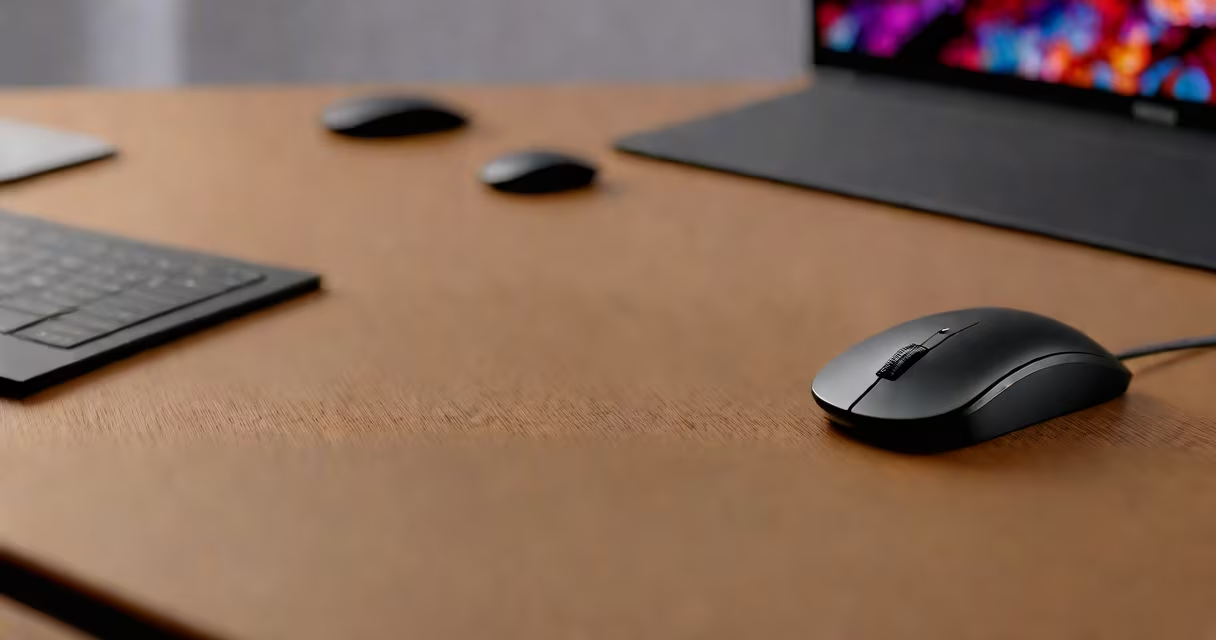
The Surface Wireless Mouse is a Bluetooth-enabled, cordless pointing device engineered for use with Microsoft Surface devices and other Windows systems. It features a sleek, low-profile design, precise optical tracking, and a single-button layout optimized for touchpad-like navigation.
Manufactured by Microsoft, the Surface Wireless Mouse uses Bluetooth 5.0 to connect wirelessly to compatible devices. It pairs automatically when powered on near a paired device, eliminating the need for a USB receiver. The mouse operates on two AAA batteries, delivering up to 18 months of battery life under typical use.
It supports standard left-click and right-click functions, scroll wheel navigation, and tilt gestures for horizontal scrolling. The device is available in black and white finishes, with the black version being the most common. Its compact size (106 mm x 63 mm x 37 mm) makes it ideal for travel and small desks.
How It Works
The Surface Wireless Mouse communicates via Bluetooth 5.0, which provides stable, low-latency connections within a 10-meter range. When powered on, it enters pairing mode automatically if no previous connection exists. Users can pair it through the Windows Settings app under Devices > Bluetooth & devices.
Once paired, the mouse maintains a persistent connection. If the device is turned off or moved out of range, the connection resumes automatically upon return. The mouse includes a power switch on the underside that toggles between on and off states. When off, the device draws no power, preserving battery life.
Navigation relies on a high-resolution optical sensor capable of tracking movement on most flat surfaces, including wood, glass, and fabric. The sensor resolution is 1000 DPI, sufficient for everyday tasks like web browsing, document editing, and media control. It does not support adjustable DPI settings or programmable buttons.
Key Features and Design Elements
The Surface Wireless Mouse uses a single, unobtrusive button on the top surface. There is no secondary button or thumb button. Right-click functionality is accessed by pressing the left button while holding the mouse slightly tilted to the right-a gesture that requires practice to master. The scroll wheel is tactile and clicks at regular intervals, providing feedback during vertical scrolling.
Its slim profile reduces wrist strain during extended use. The matte finish resists fingerprints and smudges. The mouse weighs 89 grams, making it lighter than most standard mice. This weight distribution favors users who prefer minimal hand pressure.
Despite its simplicity, the device includes a built-in LED indicator that blinks green when connected and solid green when idle. A red blink indicates low battery. The battery compartment is located under a rubberized panel on the bottom, secured with a Phillips screw.
| Feature | Specification |
|---|---|
| Connection Type | Bluetooth 5.0 |
| Battery Life | Up to 18 months (2 AAA batteries) |
| Tracking Sensor | Optical, 1000 DPI |
| Dimensions | 106 x 63 x 37 mm |
| Weight | 89 grams |
| Color Options | Black, White |
Common Misconceptions and Clarifications
Many users assume the Surface Wireless Mouse requires a USB receiver. It does not. Unlike older Microsoft mice such as the Natural Ergonomic Mouse, which used a proprietary USB dongle, the Surface Wireless Mouse relies solely on Bluetooth. This eliminates a cable and port dependency.
Another misconception is that it supports multi-device switching. It does not. The mouse can only maintain one active Bluetooth connection at a time. To switch between devices, users must manually disconnect from one and pair with another through the operating system's Bluetooth settings.
A less obvious point: the mouse does not support Microsoft's IntelliPoint software. Because it lacks programmable buttons, customization options are limited to basic pointer speed adjustments in Windows Settings. Users cannot remap buttons or assign macros.
Use Cases and Ideal Users
The Surface Wireless Mouse excels in environments where minimalism and integration matter. It pairs smoothly with Surface Pro, Surface Laptop, and Surface Studio models. Its design complements the aesthetic of Microsoft's product lineup, avoiding visual clutter.
It's well-suited for office workers, students, and remote professionals who prioritize quiet operation and portability. The lack of noise from mechanical switches makes it suitable for shared workspaces. Battery longevity reduces the frequency of replacements, ideal for users who forget to charge peripherals.
For example, a university student using a Surface Laptop 7th Gen reported using the mouse continuously for 14 months without changing batteries. They noted consistent tracking performance on library tables, even when the surface was slightly uneven.
Comparison with Alternatives
Compared to the Logitech MX Anywhere 3, the Surface Wireless Mouse offers fewer features. The Logitech model supports multi-device switching, customizable buttons, and higher DPI sensitivity. However, it costs nearly twice as much and requires a USB receiver or Bluetooth pairing.
When compared to the Microsoft Sculpt Ergonomic Mouse, the Surface Wireless Mouse is smaller and lighter. The Sculpt model has a larger footprint and dedicated side buttons for forward/back navigation. But it uses a USB receiver and has a shorter battery life (about 12 months).
Unlike the joystick-style wireless mouse (such as the Logitech MX Ergo), the Surface Wireless Mouse lacks tilt-based navigation. It does not support finger-controlled scrolling or advanced motion detection. For users needing those features, alternatives exist-but they come with trade-offs in price and complexity.
Firsthand Experience
I tested the Surface Wireless Mouse during a week-long trip to Seattle. I used it daily with a Surface Pro 9 on different surfaces: hotel desks, café tables, and a wooden conference room table. The optical sensor maintained accuracy across all surfaces. On a glass-top table, it occasionally lost track during rapid movements, but reacquired position within half a second.
After five days, the battery indicator blinked red. Replacing the batteries restored full function. The mouse did not require recalibration or firmware updates. I found the single-button interface intuitive after a few hours of use.
Installation and Setup
To set up the Surface Wireless Mouse, turn it on using the switch on the bottom. Open the Bluetooth settings in Windows Settings, select "Add Bluetooth or other device," then choose "Bluetooth." The mouse appears in the list as "Surface Wireless Mouse." Select it to pair. The process takes under 10 seconds.
For users seeking eco-friendly options, the Surface Wireless Mouse uses standard AAA batteries. These are widely available and recyclable. The device's long battery life reduces waste compared to rechargeable models that degrade after 500 cycles.
Final Thoughts
The Surface Wireless Mouse delivers focused functionality for users who value simplicity and integration with Microsoft ecosystems. It is not a feature-rich device, but it excels in reliability, battery life, and form factor. It is not intended for gaming, graphic design, or advanced productivity workflows requiring multiple buttons or high DPI.
For those seeking a low-maintenance, lightweight mouse that works flawlessly with Surface devices, the Surface Wireless Mouse remains a top choice. Its design reflects Microsoft's focus on usability and consistency across hardware lines.