
Ursaluna Blood Moon
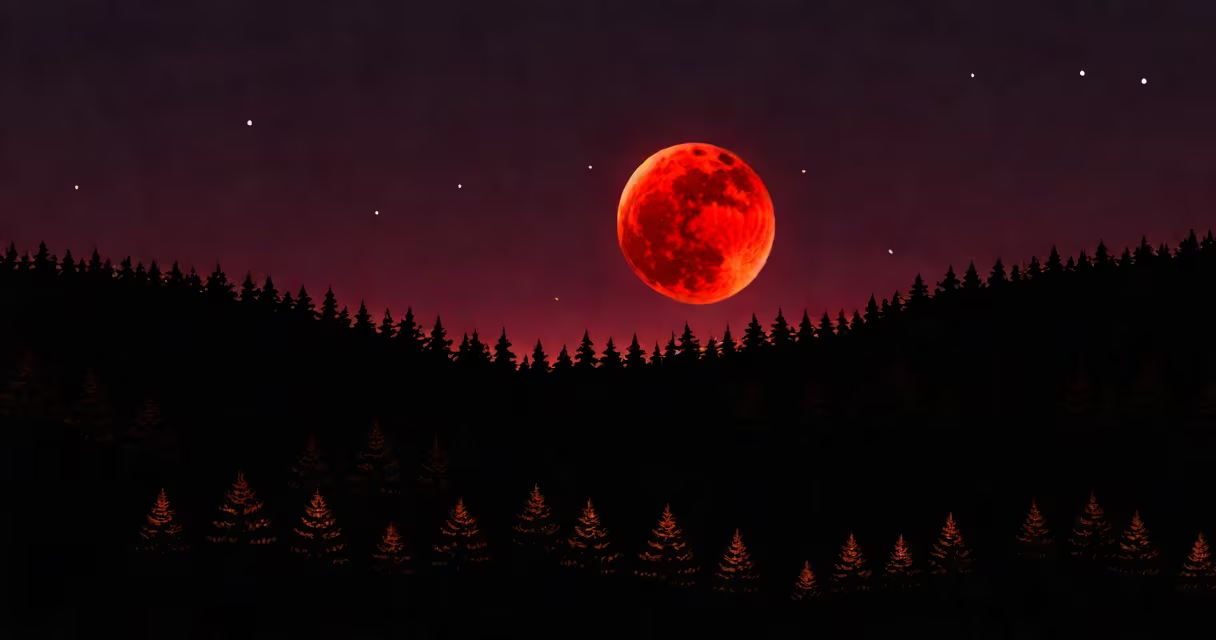
The Ursaluna blood moon is a total lunar eclipse that occurs when Earth passes directly between the Sun and the Moon, casting a shadow that turns the Moon a deep red or copper hue. This effect results from sunlight bending through Earth's atmosphere and filtering shorter wavelengths, leaving only red light to explain the Moon.
This phenomenon happens only during a full moon phase and when the Sun, Earth, and Moon align precisely in a straight line. The term "Ursaluna" combines "Ursa," referencing the Ursa Major constellation, and "luna," Latin for Moon, though it is not an official astronomical designation. The name gained traction in online astronomy communities and speculative fiction due to its evocative sound and association with rare celestial events.
Not all lunar eclipses produce a blood moon. The color intensity depends on atmospheric conditions-dust, pollution, volcanic ash, and cloud cover can deepen or mute the red tone. A total eclipse lasting over 100 minutes increases the chance of a vivid red appearance.
How It Forms
A total lunar eclipse begins when the Moon enters Earth's umbra-the darkest part of the shadow. As it moves deeper, sunlight passing through Earth's atmosphere gets refracted and scattered. Blue light is absorbed, while red and orange wavelengths pass through and reflect off the Moon's surface.
For example, during the total lunar eclipse on November 8, 2022, observers in North America saw the Moon turn a rich rust-red. NASA reported that high-altitude dust from the Hunga Tonga-Hunga Ha'apai eruption in January 2022 contributed to the unusually dark hue, demonstrating how atmospheric composition affects visual outcome.
Unlike solar eclipses, which require eye protection, lunar eclipses are safe to view with the naked eye. They last longer-up to nearly 1.5 hours in totality-and are visible across entire continents during peak moments.
Types and Conditions
Lunar eclipses fall into three categories: penumbral, partial, and total. Only total eclipses result in a blood moon. Penumbral eclipses cause subtle dimming; partial eclipses show a bite taken out of the Moon. Total eclipses are the only ones where the red glow becomes apparent.
| Eclipse Type | Duration of Totality | Color Observed | Visibility Range |
|---|---|---|---|
| Total lunar | Up to 106 minutes | Red, copper, or dark brown | Half the globe |
| Partial lunar | 30-60 minutes | Partial shading, no red glow | Regional |
| Penumbral lunar | 1-2 hours | Subtle dimming | Widespread but hard to detect |
Atmospheric clarity matters. After the 2018 volcanic eruption in Indonesia, the following lunar eclipse showed a darker red than usual due to increased stratospheric aerosols. Scientists at the European Space Agency noted that such particles scatter blue light more efficiently, enhancing red transmission.
Common Misconceptions
"Ursaluna blood moon" is not a scientific term. It is a cultural or fictional label used in fantasy literature, video games, and social media. Some confuse it with a "supermoon"-a full moon near perigee-but they are unrelated. Supermoons appear larger and brighter but do not turn red.
Another error is assuming all red Moons are blood moons. A Moon may appear reddish during moonrise or moonset due to atmospheric scattering, but this is not an eclipse. The true blood moon requires Earth's shadow to fully envelop the Moon.
I once witnessed a total lunar eclipse in 2019 from a rural area in Montana. With minimal light pollution, the Moon turned a deep maroon as it entered totality. The effect was dramatic-like a slow-motion transformation from silver to fire. That night, I realized how much beauty lies in predictable natural cycles.
Why It Matters
While the Ursaluna blood moon holds no scientific weight, the phenomenon itself does. Lunar eclipses provide opportunities to study Earth's atmosphere and orbital mechanics. Observations during eclipses help refine models of atmospheric refraction and Earth's rotational stability.
Historically, lunar eclipses were used to calibrate calendars. Ancient Babylonians recorded eclipse patterns to predict future events. Today, astronomers use precise timing data from eclipses to verify orbital models. For example, the 2021 eclipse helped confirm slight variations in Earth's rotation caused by tidal friction.
When the Moon is in the umbra, its brightness drops by about 90%. This change is measurable with standard cameras and even smartphone sensors. Citizen science projects like the Global Eclipse Project collect photos from around the world to analyze color variation across regions.
Where and When to See It
Ursaluna blood moon events occur roughly every 2.5 years, but visibility varies by location. The next total lunar eclipse visible from North America will be on March 13-14, 2025. It will be visible across most of the United States, Canada, and parts of Central America.
Always check local weather forecasts. Cloud cover can block the view entirely. If you're planning to photograph the event, use a tripod and manual focus. Set your camera to ISO 800-1600, f/4-f/5.6, and shutter speed between 1/15 sec and 1 sec during totality.
Understanding the Ursaluna blood moon begins with recognizing it as a poetic name for a real astronomical event. The red Moon is not magic-it's physics. But the awe it inspires is very real.
Knowing how the Earth's atmosphere filters sunlight to create the blood moon helps us appreciate both science and wonder. The next time you see a red Moon, remember: it's not a sign, but a spectacle shaped by planetary alignment and atmospheric science.